
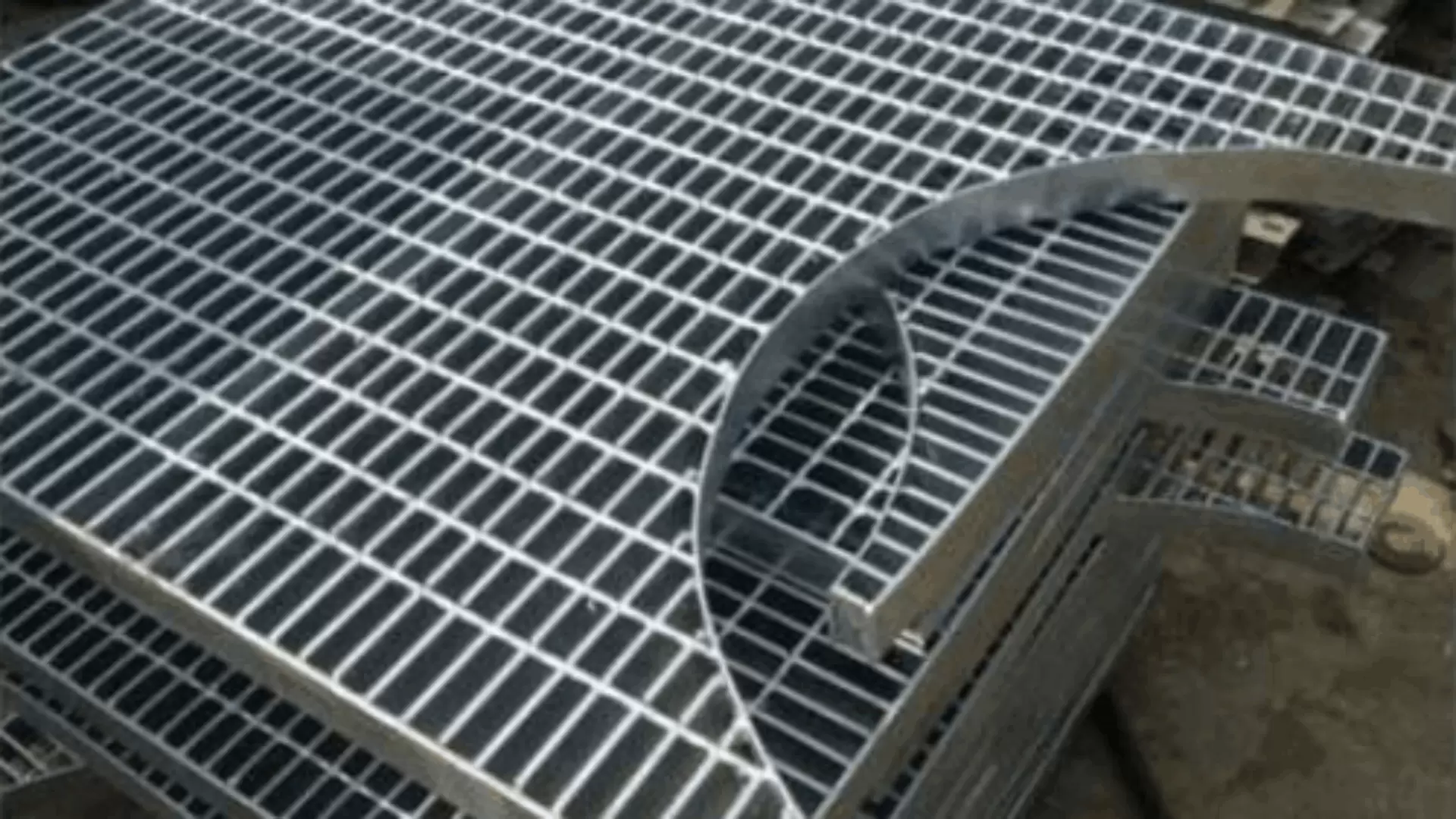
Among the many flooring and platform materials used in industrial construction, MS grating remains one of the most widely specified because it pairs mild steel’s strength and affordability with the open, drainage-friendly design that industrial environments demand. Whether it is a factory mezzanine, a stair tread, or a trench cover, MS grating shows up almost everywhere heavy foot or equipment traffic meets the need for ventilation and drainage.
What Is MS Grating?
MS grating, short for mild steel grating, is a load-bearing floor panel fabricated from mild steel bars arranged in an open lattice pattern. Bearing bars run in one direction to carry the primary load, while cross bars run perpendicular to hold the structure together and distribute load evenly across the panel. Mild steel is chosen for its strength, weldability, and lower cost compared to stainless steel, making it the standard material for general industrial applications where extreme corrosion resistance is not the primary concern.
Manufacturing Methods for MS Grating
- Welded (Electroforged) MS Grating – Cross bars are completely fused to bearing bars at every junction using high-voltage electrical resistance and hydraulic pressure. This produces a single-piece homogenous panel with maximum rigidity and the highest load capacity, perfectly suited to heavy industrial flooring.
- Manual MS Grating – Fabricated by skilled welders who manually weld the cross bars into pre-slotted or positioned bearing bars. This traditional method offers exceptional flexibility for low-volume orders, custom structural dimensions, or irregular layouts where automated lines cannot adapt easily.
Where MS Grating Is Used
Because it balances cost and performance so effectively, MS grating is found across a wide range of industrial and infrastructure settings: factory floors and mezzanines, walkways and catwalks connecting equipment, stair treads on industrial staircases, trench and drain covers, safety barriers and fencing panels, and ventilation flooring in boiler rooms and machine areas. Its open design lets heat, dust, and liquid pass through rather than collecting on the surface, which is a major safety advantage in processing and manufacturing environments.
MS Grating Specifications to Check
- Bearing bar size – Common sizes range from 20×3 mm to 50×5 mm depending on the load and span requirement; deeper bars handle longer spans and heavier loads.
- Bar spacing – Standard spacing balances open area for drainage against load distribution; tighter spacing suits areas with smaller equipment wheels or fine debris.
- Panel size – Standard panels are typically around 1000 x 6000 mm, though custom sizes are common for irregular site layouts.
- Finish – Hot-dip galvanising is standard for outdoor or humid environments, while painted or mill-finish panels suit dry, indoor, low-corrosion settings.
- Surface type – Plain bars for general flooring, serrated bars for additional slip resistance in oily or wet zones.
MS Grating vs Stainless Steel Grating
Stainless steel grating offers superior corrosion resistance and is the right choice for chemical plants, food processing, or marine environments. For most general industrial flooring, however, MS grating with a proper hot-dip galvanised finish delivers comparable durability at a significantly lower cost. The decision usually comes down to the specific corrosive exposure of the site: if the environment involves harsh chemicals or constant moisture, stainless steel is worth the premium; otherwise, galvanised MS grating is the more economical and equally reliable option.
Installation Tips
MS grating panels should be secured to their supporting steel frame using saddle clips, J-clips, or bolted fasteners suited to the bearing bar size, ensuring panels do not shift under vibration or load. Cut edges exposed during on-site trimming should be re-coated with a zinc-rich primer to maintain corrosion protection where the original galvanised layer has been disturbed. Spanning distances should always stay within the manufacturer’s recommended limits for the chosen bearing bar size and expected load.
How to Choose a Reliable MS Grating Supplier
Since MS grating is used in load-bearing applications, fabrication quality directly affects worker safety. Buyers should confirm that the supplier provides load-span charts specific to their bar sizes, can supply test certificates for the steel grade used, and offers in-house customisation for irregular panel shapes such as trench covers or equipment cut-outs. Manufacturers who control the entire welding and galvanising process tend to deliver more consistent quality than traders sourcing from multiple unverified sources.
Conclusion
MS grating continues to be the workhorse of industrial flooring because it delivers proven strength, easy fabrication, and dependable performance at a cost that suits large-scale projects. Choosing the right bar size, spacing, and finish for the application ensures the grating performs safely for decades. Greatweld Engineering manufactures electroforged and manual welded MS grating panels engineered for industrial platforms, walkways, and trench covers, fabricated in-house with consistent quality control. View the full range on the MS Grating page.
Frequently Asked Questions (FAQs)
MS grating stands for mild steel grating, referring to the low-carbon steel grade used to fabricate these open-lattice flooring and platform panels.
Electroforged MS grating uses heavy automated machinery to fuse the intersections seamlessly. This results in uniform weld strength, a cleaner appearance, and higher resistance to structural deformation under heavy industrial loads compared to manually welded alternatives.
Yes, provided it has a hot-dip galvanised or equivalent corrosion-resistant finish; plain mild steel without a coating will rust quickly in outdoor or humid conditions.
Most manufacturers produce standard panels around 1000 x 6000 mm, though custom dimensions are available to match specific site or equipment requirements.
Bearing bar size depends on the span between supports and the expected load; it is best confirmed against the manufacturer’s load-span table rather than estimated.
https://shorturl.fm/hvJlu
https://shorturl.fm/zek60
https://shorturl.fm/1SVxT
https://shorturl.fm/f5ZwA
https://shorturl.fm/nNJQS
https://shorturl.fm/uzWAL
https://shorturl.fm/cMbyl
https://shorturl.fm/bgAAC
https://shorturl.fm/taCon
https://shorturl.fm/5OBGr
https://shorturl.fm/NRxnG