Industrial flooring that lasts for decades in outdoor, wet, and chemically exposed environments must do more than carry structural load.
It must resist corrosion from the first day of installation through the final year of service life.
Galvanized steel grating is the product that delivers both of these requirements together.
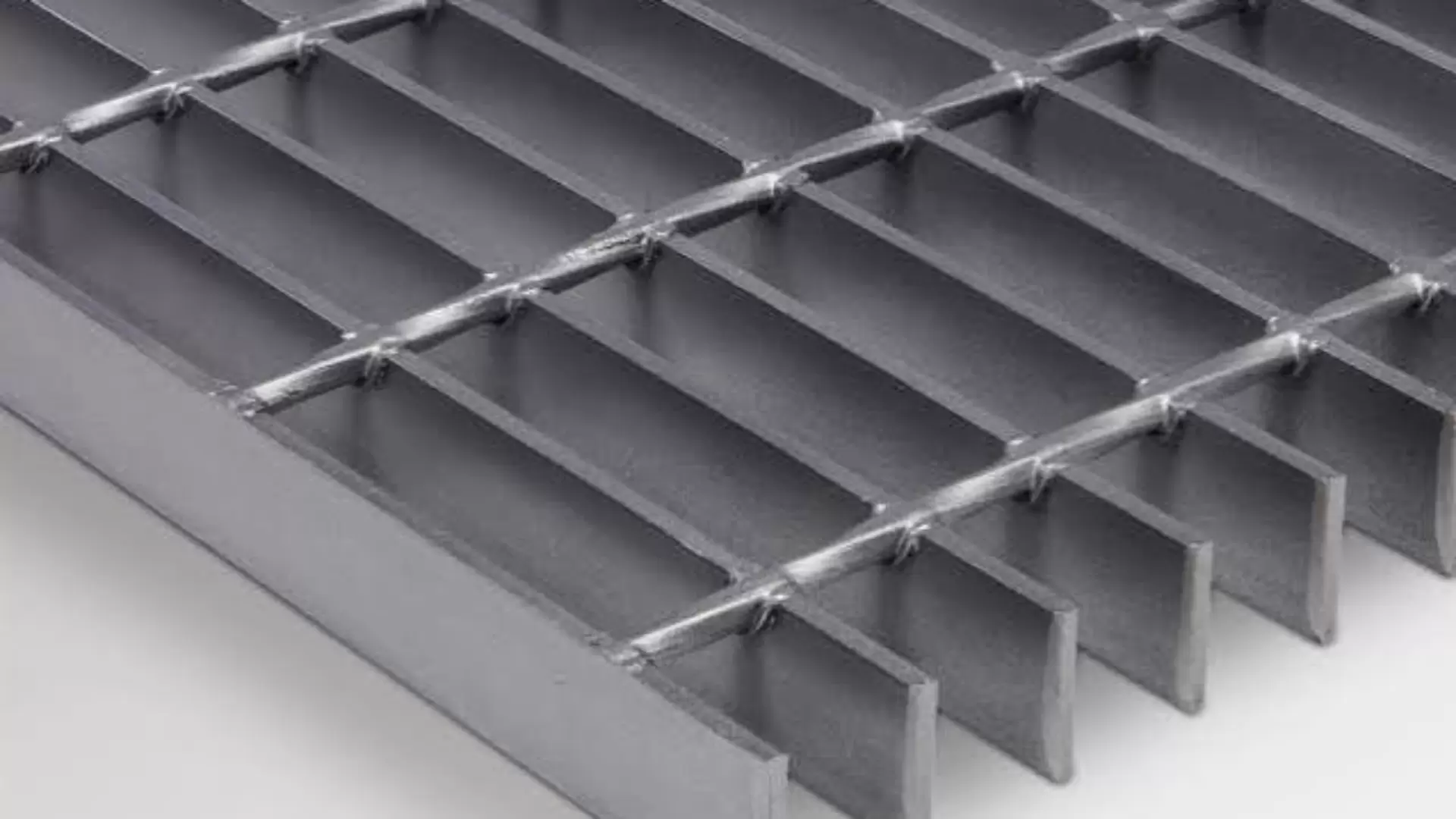
The welded or electroforged grating panel provides the structural performance while the hot-dip zinc coating provides the long-term corrosion defence.
Greatweld Engineering is a Pune-based steel grating manufacturer that produces electroforged and manually welded grating panels with hot-dip galvanising applied in-house after fabrication.
This guide explains what galvanized steel grating is, how the galvanizing process works on a finished grating panel, our product specifications, and the applications we serve.
What Is Galvanized Steel Grating
Galvanized steel grating is an open-bar steel grating panel that has been coated with zinc through the hot-dip galvanizing process after full fabrication.
The zinc coating bonds metallurgically to every steel surface it contacts, including bearing bars, cross bars, weld joints, and cut edges.
This full-surface coverage is what distinguishes hot-dip galvanised grating from pre-galvanised or painted alternatives.
Pre-galvanised panels leave every weld zone unprotected because the fabrication heat destroys the zinc coating at each joint.
Painted panels leave internal grating surfaces and complex weld geometries uncoated because spray and brush application cannot reach every surface uniformly.
Galvanized steel grating panels can be installed in outdoor, high-humidity, coastal, and chemical environments without risk of accelerated corrosion.
The Hot-Dip Galvanizing Process for Grating Panels
Surface Preparation
Before galvanizing, every fabricated grating panel is cleaned to remove mill scale, oil, and surface contamination.
Cleaning involves degreasing followed by acid pickling in a hydrochloric acid solution.
Thorough surface preparation is critical because the zinc coating cannot adhere to steel that retains any contamination.
Rinsing after pickling removes residual acid before the panel moves to the next stage.
Fluxing
After pickling and rinsing, each panel passes through a flux bath of zinc ammonium chloride solution.
The flux prevents re-oxidation of the clean steel surface in the period between pickling and zinc immersion.
A clean, properly fluxed surface is essential for achieving a uniform, fully adhered zinc coating across the entire panel.
The Galvanizing Bath
The prepared grating panel is immersed in a bath of molten zinc maintained at approximately 450 degrees Celsius.
The zinc reacts with the iron in the steel surface to form a series of zinc-iron alloy layers bonded to the steel.
This metallurgical bond makes the coating an integral part of the steel rather than a surface layer that can peel or flake.
An outer layer of pure zinc forms on top of the alloy layers, providing the primary long-term corrosion barrier.
Inspection and Quality Control
Every galvanized steel grating panel is inspected for coating uniformity, thickness, and surface adhesion after the bath.
Zinc coating thickness is measured using a calibrated magnetic gauge and compared against IS 2629 specification requirements.
Any areas with thin coating or bare spots are identified and remedied before the panel is approved for dispatch.
Greatweld Engineering maintains galvanizing records for all panels supplied on projects requiring documented quality assurance.
Why Hot-Dip Galvanizing Is the Correct Finish for Steel Grating
Painted coatings fail quickly on steel grating because the complex open geometry makes uniform paint application almost impossible.
Welds, rung undersides, and bar intersections are routinely missed, leaving unprotected steel to corrode within months in a wet environment.
Pre-galvanised steel loses its zinc protection at every weld joint during fabrication, leaving those areas exposed from the first day of installation.
Hot-dip galvanizing applied to the fully fabricated panel is the only coating method that reliably protects every surface of a steel grating panel.
Galvanized steel grating provides a minimum service life of 25 years in outdoor industrial environments and up to 50 years in less aggressive conditions.
Over a 25-year project life, the zero-maintenance cost of galvanised grating consistently makes it less expensive than repeated painting of untreated steel.
Galvanized Steel Grating Specifications at Greatweld Engineering
Bearing bar sizes from 20 mm x 3 mm to 65 mm x 6 mm depending on the load and span requirement.
Bearing bar spacing from 25 mm to 60 mm centre to centre depending on the required open area and load distribution.
Cross bar spacing from 50 mm to 100 mm depending on the grating type and application.
Standard panel size is 1000 mm x 6000 mm. Custom dimensions are available for project-specific requirements.
Zinc coating thickness conforms to IS 2629 requirements for the relevant exposure class of the installation environment.
Serrated bearing bars are available for all panel sizes to provide enhanced slip resistance in wet or oily conditions.
Edge banding is applied to all cut panels to maintain structural integrity and provide a clean fit within the support frame.
Galvanized vs Painted Steel Grating: A Practical Comparison
Painted steel grating typically requires repainting every three to seven years in outdoor industrial conditions to maintain corrosion protection.
Galvanized steel grating requires no repainting for 25 to 50 years in most industrial environments.
The repainting cycle for painted grating creates ongoing maintenance cost, facility downtime, and waste material disposal requirements.
For projects with long design service lives, the total cost of ownership for galvanized steel grating is consistently lower than painted steel grating.
A painted finish may be acceptable for dry, indoor, climate-controlled installations where the grating is never exposed to moisture or chemicals.
For any outdoor, coastal, humid, or chemically exposed installation, hot-dip galvanised steel grating is the correct and most cost-effective specification.
Greatweld Engineering as Steel Grating Manufacturers
Greatweld Engineering manufactures electroforged and manually welded galvanized steel grating panels at our Alandi, Pune facility.
We control every stage of production from raw steel receipt, cutting, and panel fabrication through to in-house hot-dip galvanising and dimensional inspection.
Material test certificates confirming IS 2062 steel grade, load-span charts for all bearing bar configurations, and galvanizing records are available with every order.
As steel grating manufacturers with direct control over the galvanizing process, we can confirm coating thickness compliance for every batch we supply.
Custom panel dimensions, non-standard bearing bar sizes, close-spaced cross bars, and serrated surface options are available for project-specific requirements.
Greatweld Engineering supplies galvanized steel grating to power sector, industrial construction, infrastructure, and process industry clients across India.
Applications
Power plant cable galleries, transformer bays, and maintenance platforms use galvanized steel grating for its outdoor durability and long service life.
Industrial platforms and mezzanines in coastal and humid environments specify galvanized grating because untreated steel would corrode unacceptably in the same conditions.
Trench covers in outdoor process areas require galvanized steel grating to resist water, chemical splashes, and continuous atmospheric exposure.
Walkways on jetties, marine platforms, and bridge structures specify hot-dip galvanised grating for resistance to salt spray and tidal moisture.
Water treatment plants, pumping stations, and municipal infrastructure use galvanized steel grating for platforms, access covers, and walkways across water-exposed areas.
Conclusion
Galvanized steel grating is the most durable and cost-effective flooring choice for any industrial installation exposed to outdoor conditions, moisture, or corrosive environments.
The quality of the galvanizing process determines how long that protection lasts, which is why steel grating manufacturers who apply galvanizing in-house after fabrication consistently outperform those who outsource the process.
Greatweld Engineering manufactures galvanized steel grating with complete in-house control over fabrication quality and zinc coating application.
Contact Greatweld Engineering with your panel size, bearing bar specification, and project environment details for a product recommendation and quotation.
Frequently Asked Questions (FAQs)
Galvanized steel grating has a zinc coating applied through hot-dip galvanizing after full fabrication. The zinc bonds metallurgically to every surface including welds and edges. Painted grating has a surface coating that cannot reach internal surfaces and requires repainting every few years. Galvanized grating lasts 25 to 50 years without maintenance.
Applying galvanizing after fabrication ensures every surface of the finished panel is protected including welds, cut edges, and punched holes. Pre-galvanising raw steel before welding leaves every weld zone unprotected because fabrication heat destroys the zinc coating at the weld location.
IS 2629 is the Indian standard that specifies the hot-dip galvanizing process requirements and minimum zinc coating thickness for different service environments. Greatweld Engineering applies galvanizing to all grating panels in accordance with IS 2629.
Greatweld Engineering supplies galvanized steel grating with bearing bar sizes from 20 mm x 3 mm to 65 mm x 6 mm. The correct size depends on the expected load and the support span of the installation. Load-span charts are available for all configurations.
Hot-dip galvanised steel grating typically lasts 25 years or more in outdoor industrial environments in India. In less aggressive inland conditions the service life can extend to 50 years. Coastal and chemical environments shorten the lifespan but galvanized grating still significantly outperforms painted alternatives.