
There’s one piece of electrical infrastructure that rarely gets talked about but ends up carrying more responsibility than almost anything else in the building -the cable tray. Walk through a power plant, a data center, or a commercial high-rise, and you’ll find miles of cable that all need to be organized, protected, and kept cool. That job falls squarely on the tray system running above your head or along the walls, and its quality matters more than most people realize.
Greatweld Engineering is one of India’s established cable tray manufacturers, building cable management systems meant to hold up for the long haul – structurally sound, safe to work around, and able to handle whatever environment they’re installed in. Here’s a closer look at what we make, what actually separates a good manufacturer from an average one, and where these systems tend to show up.
What Cable Trays Actually Do
A cable tray is essentially a rigid support structure that routes and organizes electrical cables through industrial, commercial, and residential spaces. Without one, cables end up loose, bundled together haphazardly, or strung in ways that are unsafe and hard to maintain. A properly built tray system solves that by keeping everything organized, ventilated, and shielded from dust, moisture, and physical damage.
A tray system that’s actually engineered well needs to do three things without cutting corners:
- Carry the weight of the cables without sagging or warping over time
- Let heat escape so cables don’t run hot
- Keep out environmental damage and unwanted tampering
What GreatWeld Engineering Manufactures
Not every application calls for the same tray, and manufacturers who understand that tend to build a broader, more useful range. Here’s what we offer:
Perforated Cable Trays These work well for light to medium cable loads. The perforated design helps with heat dissipation while also keeping dust and moisture from building up inside. Our perforated trays meet IEC 61537:2023, come in widths from 150mm to 1000mm, and are available in mild steel and aluminium, with finish options including pre-galvanized, powder coated, painted, and hot-dip galvanized.
Ladder-Type Cable Trays When the load is heavy and the environment is demanding, ladder-type trays are usually the better fit. Their open-rung design offers strong ventilation and makes it easy to add or remove cables as needed — which is a big part of why they’re so common in power plants and data centers. We build these in both welded and bolted configurations depending on what the site calls for.
Raceways / Trunking Cable Trays For situations where protection matters more than airflow, enclosed raceway and trunking trays are the answer. They shield cables from dust, moisture, and physical impact, and they’re a popular choice for IT companies and commercial spaces that want their wiring concealed and tidy.
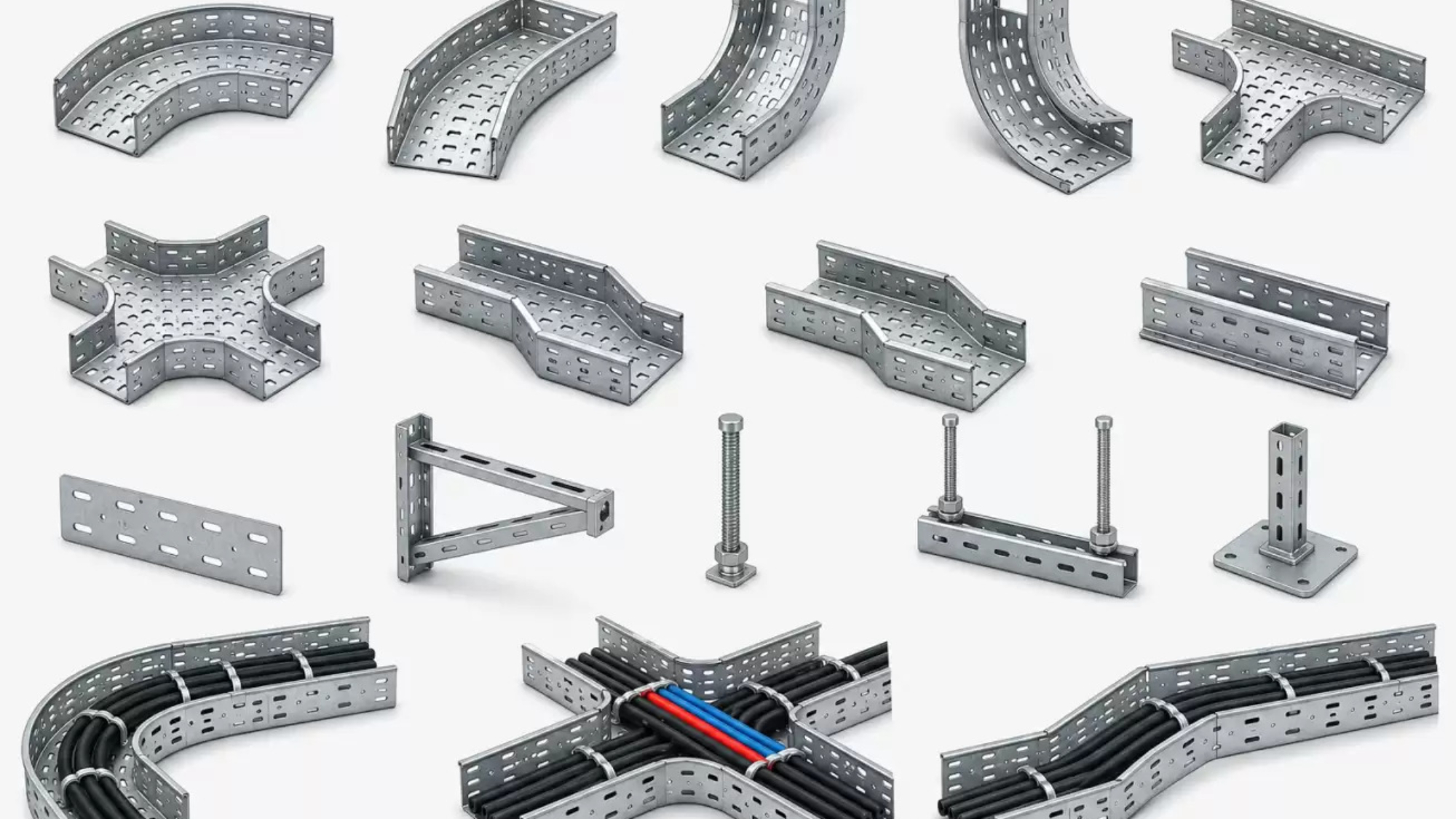
Cable Tray Accessories No tray system is complete without the right fittings to go with it. We supply horizontal and vertical bends, crosses and tees, reducers, and coupler plates — the components that make installation smoother and let the whole layout adapt to whatever the site throws at it.
Where These Systems Get Used
GreatWeld Engineering’s cable trays end up in a wide range of settings, including:
- Industrial plants and manufacturing units
- Commercial buildings and office complexes
- Data centers
- Hospitals
- Railways
- Airports
You can see real examples of how our products are deployed across these sectors on our applications page.
What to Actually Look for in a Cable Tray Manufacturer
The manufacturer you choose has a direct effect on how safe and how long-lasting your electrical system will be. A few things worth checking before placing an order:
Standards compliance — Look for compliance with IEC 61537:2023, plus the relevant IS standards: IS-277 for pre-galvanizing and IS-2629 for hot-dip galvanizing.
Material and finish options — A capable manufacturer should offer more than one material and finish, so you can match the tray to your load and corrosion requirements rather than settling for whatever’s on hand.
Dimensional flexibility — Widths from 150mm to 1000mm and thicknesses from 1.2mm to 3.0mm should be available to fit your project specs, not the other way around.
Sustainability practices — GreatWeld Engineering builds with recyclable materials, relies on natural airflow to support energy efficiency, and follows low-carbon manufacturing practices.
A full product ecosystem — Ideally, your trays, accessories, and related structural products — things like handrails and steel gratings — come from one trusted source. It simplifies procurement and keeps everything compatible from the start.
Frequently Asked Questions (FAQs)
Perforated trays are ventilated, enclosed-bottom trays best suited for light to medium cable loads, offering protection from dust and moisture. Ladder-type trays have an open-rung design and are built for heavy-duty applications with higher load-bearing needs, like power plants and data centers.
It comes down to the environment. Mild steel with a galvanized finish is a cost-effective choice for standard indoor use. Aluminium is lightweight and works well where weight is a concern, such as in certain commercial or coastal installations.
Cable trays should comply with IEC 61537:2023 for design and performance, along with IS-277 for pre-galvanizing and IS-2629 for hot-dip galvanizing, depending on the finish required.
Yes. GreatWeld Engineering offers cable trays in widths from 150mm to 1000mm and thicknesses from 1.2mm to 3.0mm, with custom configurations available based on project requirements.
Yes. Depending on the finish selected — hot-dip galvanized, powder coated, or otherwise — and the material chosen, our cable trays hold up well in both indoor and outdoor industrial environments, including power plants, railways, and airports.
We offer a full range of cable tray accessories, including horizontal and vertical bends, crosses, tees, reducers, and coupler plates, to keep installation smooth across even the more complex layouts.