
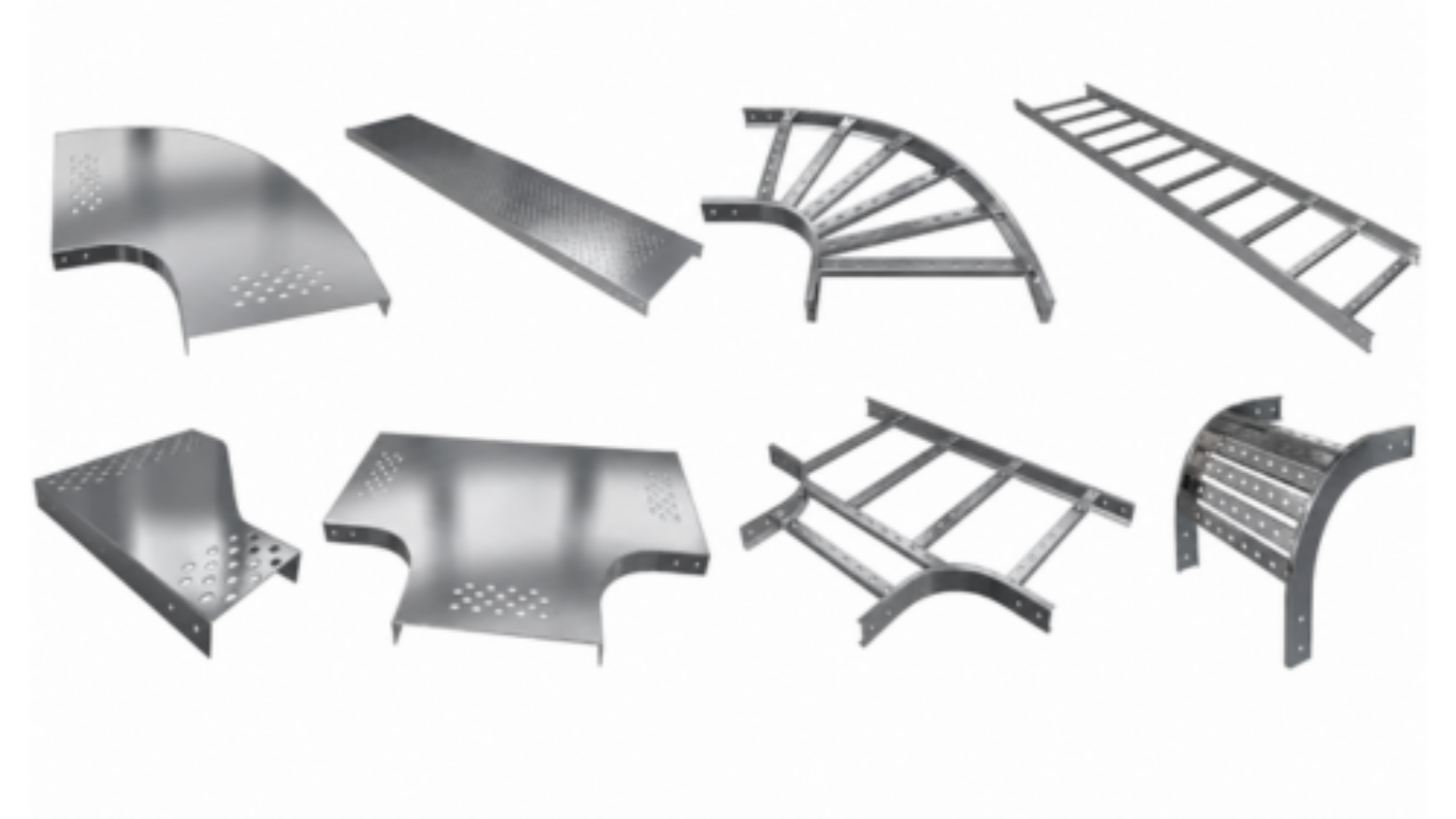
A ladder type cable tray is an open cable support made of two side rails joined by cross members called rungs. It holds power, control and instrumentation cables while letting air move freely around them. It suits long runs, heavy cables and areas where heat dissipation and easy access matter.
What Is a Ladder Type Cable Tray and How Is It Built?
The design resembles a ladder laid on its side. The side rails carry the main load along the run. The rungs connect the rails and support the cables from below. Cables rest on the rungs at set intervals instead of on a solid base.
Main components
- Side rails that form the length and set the loading depth.
- Rungs that connect the rails and carry the cables.
- Splice or coupler plates that join straight sections.
- Supports such as wall brackets, hangers and trapeze frames.
- Accessories such as bends, tees, crosses, reducers, covers and dividers, depending on the system.
How Does a Ladder Type Cable Tray Support Cable Routing?
The open structure lets heat escape from cables, which is useful for loaded power circuits. Dust and moisture do not collect on a solid floor, because there is none. Cables can be tied to the rungs, and they can leave the tray from the top or the sides. Installers and maintenance teams can also see the full cable run, add new cables later and inspect existing ones without removing covers. Fittings help keep cables within their minimum bend radius at changes of direction.
Common Types and Configurations
Manufacturers group ladder trays in different ways. Treat the list below as general industry practice and confirm each option with the supplier.
- By construction, welded assemblies or bolted and formed systems.
- By duty, light, medium or heavy, based on rated load and support span.
- By installation, horizontal runs, vertical risers, wall mounted, trapeze hung or rack mounted.
- By protection, open runs or runs with covers where debris, sun or falling objects are a concern.
Standard Sizes and Dimensions to Consider
Sizes vary by manufacturer, project standard and region. The main dimensions are tray width, side rail height, straight length, material thickness and rung spacing. Width must hold the cables with space for future additions and for cable spacing where required. Side rail height sets the usable cable depth and affects stiffness. Confirm all sizes against the supplier’s current drawing or catalogue.
Why Does Rung Spacing Matter?
Rung spacing is the distance between neighbouring rungs. Large, stiff power cables keep their shape between rungs, so wider spacing can work. Small, flexible cables can sag between widely spaced rungs and are harder to dress neatly. Many catalogues offer spacing in a range of roughly 150 mm to 300 mm, but you should confirm the options for your project. If a run carries many small cables, consider tighter spacing, a perforated tray or an added support layer.
Cable Load, Span, Support Spacing and Deflection
Tray capacity depends on load per metre, the distance between supports and the allowed deflection. Total load includes cable weight, planned future cables, the tray’s own weight and other site loads. A longer span increases deflection, so closer supports may be needed. Use the manufacturer’s load and span data for the exact tray. If your specification names a standard such as IEC 61537 or NEMA VE 1, ask how the tray is rated against it. Do not choose a tray by width alone.
Material Options and Surface Finishes
These are general industry options. Availability from any supplier, including Greatweld, should be confirmed for your enquiry.
- Mild steel, usually painted or coated, for dry indoor areas.
- Pre-galvanised steel for general indoor use with moderate exposure.
- Hot dip galvanised steel for outdoor, humid and industrial areas.
- Stainless steel for aggressive or hygienic environments.
- Aluminium where low weight and natural corrosion resistance are priorities.
Where Is a Ladder Type Cable Tray Used?
Industrial plants use it for long power and control cable routes between switchgear, motors and panels. Power distribution sites use it in substations and switch rooms. Commercial buildings use it in service floors and risers. Infrastructure projects such as tunnels, airports and transport facilities use it where long, accessible cable routes are needed.
Ladder Type Cable Tray vs Perforated Cable Tray
| Feature | Ladder tray | Perforated tray |
| Base | Open, with cross rungs | Solid base with punched holes |
| Ventilation | High | Moderate |
| Cable support | At rung points | Continuous along the base |
| Small cables | May sag between rungs | Better continuous support |
| Typical use | Heavy power cables and long runs | Mixed cables and general routes |
Neither type is better in every case. The cable type, load, spacing and environment decide the choice.
Specification Checklist Before You Order
| Parameter | What to confirm |
| Tray width and side rail height | Width for cable fill and future additions, rail height for usable depth and stiffness |
| Material and thickness | Mild steel, galvanised steel, stainless steel or aluminium, with sheet thickness stated |
| Rung spacing | Suitable for the smallest cable on the run |
| Surface finish | Paint, pre-galvanised, hot dip galvanised or other, with the standard named |
| Cable loading | Cable weight per metre, future allowance and rated load |
| Support spacing | Support type and maximum spacing from the manufacturer’s load data |
| Installation environment | Indoor or outdoor, temperature, moisture, chemicals and sunlight |
What Should You Check Before Selecting a Tray?
Begin with the cable schedule, which lists cable types, diameters and weights. Review the route drawing for bends, risers and obstructions, because each direction change needs a matching fitting. Confirm how the tray will be supported and bonded, and whether covers or dividers are needed.
Common Selection and Installation Mistakes
- Choosing a tray by width alone without checking load and span.
- Using wide rung spacing on runs full of small cables.
- Leaving no allowance for future cables.
- Setting support spacing by habit instead of load data.
- Forcing cables below their minimum bend radius at fittings.
- Skipping bonding continuity across joints where the design requires it.
How Greatweld Can Help With Cable Tray Enquiries
Greatweld lists cable management systems on its website. Send your cable schedule, route drawings, environment, finish requirement and applicable standard to the team. Sizes, materials, load ratings and availability are confirmed against your project requirements, because they are not stated in this guide.
Frequently Asked Questions (FAQs)
A ladder type cable tray supports power, control and instrumentation cables over long runs. Its open design helps heat escape and makes inspection and later cable additions easier.
A ladder type cable tray has open rungs and gives high ventilation. A perforated tray has a solid base with holes, which supports small cables continuously. The cable type and environment decide the better choice.
Choose spacing based on the smallest cable on the run. Stiff power cables tolerate wider spacing, while small flexible cables need tighter spacing or a different tray type. Confirm available options with the supplier.
Use the manufacturer’s load and span data with your cable load per metre and deflection limit. Support spacing changes with tray size, material and rated load, so do not assume a standard figure.
Hot dip galvanised steel, stainless steel and aluminium are commonly considered for outdoor use. The right choice depends on the environment, budget and project specification, and availability should be confirmed with the supplier.