
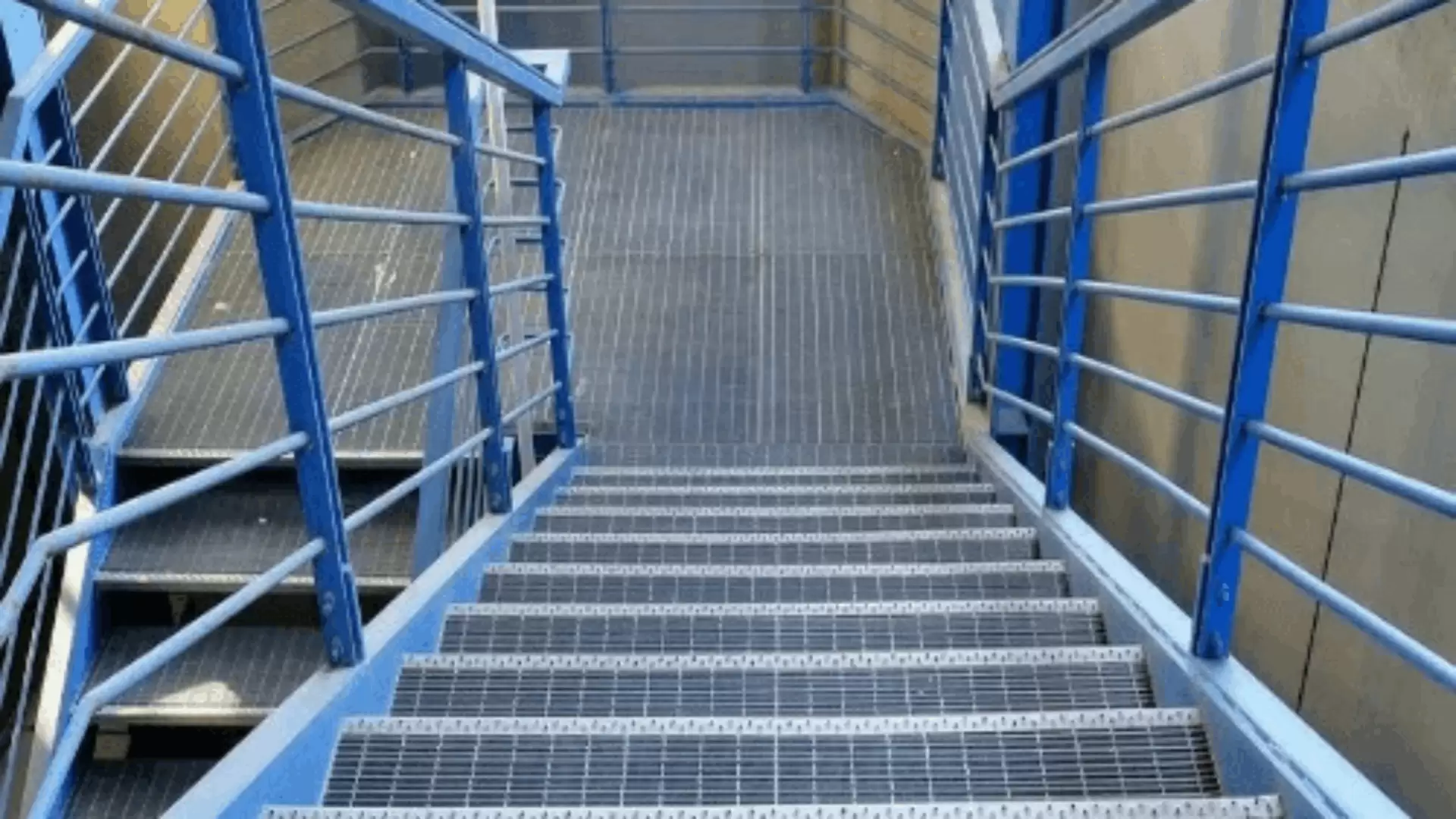
Walk onto any factory floor, oil rig, or warehouse mezzanine, and there’s one detail underfoot that quietly determines whether workers stay safe or get hurt by the quality of the steps. Stair Tread and Step Grating are two terms you’ll encounter regularly in industrial construction and facility management. Yet many procurement teams and project managers treat them as interchangeable, order the wrong product, and end up with safety gaps or unnecessary replacement costs.
This guide breaks down exactly what each product is, how they compare, where they’re used, and what to look for before you place an order. If you’re an engineer, contractor, architect, or industrial buyer, this is the reference you need.
What Is a Stair Tread?
A Stair Tread is the horizontal surface of a step the part your foot actually lands on. In industrial and commercial settings, manufacturers produce these components from high-quality mild steel and install them onto stair stringers or frames.
Industrial Stair Tread units go beyond basic flat plates. They are engineered for performance in demanding environments: high foot traffic, heavy loads, oil exposure, moisture, and constant vibration. They incorporate slip-resistant surfaces, structural reinforcement, and protective coatings that keep them functional and safe over long service lives.
The production process involves precision cutting, welding, galvanizing, and forming. Each step in that process contributes to the tread’s structural integrity and its ability to meet safety standards in real-world use.
What Is Step Grating?
Step Grating refers specifically to the open-grid panel used as the walking surface of a stair tread. Rather than a solid plate, Step Grating features a grid of bearing bars and cross bars, leaving open spaces between them. These openings are what distinguish it from solid alternatives.
The open-grid design solves a very practical problem in industrial environments: liquid and debris accumulation. Water, oil, and grit drain straight through Step Grating, keeping the walking surface dry and clear at all times. This characteristic makes it particularly valuable in environments where spills, condensation, or outdoor exposure are routine.
Step grating panels can be manufactured using three distinct methods electroforged, manually welded, each delivering a different balance of strength, appearance, and installation flexibility.
Are Stair Tread and Step Grating the Same Thing?
Not exactly though the terms are closely related. A Stair Tread is the complete step unit, including the frame, the walking surface, and features like anti-slip nosing. Step Grating is the grid-based walking surface panel itself, which forms the core of most industrial stair tread designs.
In practical use, when someone says they need Stair Tread with Step Grating, they mean a complete step unit built around an open-grid grating surface. Both terms often appear together because in the industrial context, step grating is the standard surface choice for stair treads rather than solid plate or chequered steel.
Key Features of Industrial Stair Tread & Step Grating
Serrated Surface for Enhanced Slip Resistance
The bearing bars on industrial Stair Tread panels typically feature a serrated profile. These fine ridges create a textured grip surface that significantly increases friction underfoot, particularly in wet, oily, or dusty conditions.
Anti-Slip Nosing
The front edge of a stair tread the nosing is where foot contact is most critical. Anti-slip nosing provides extra grip precisely at that leading edge, reducing the risk of slipping when stepping up or down.
Open-Grid Design for Drainage and Ventilation
The open grid of Step Grating allows water, oil, and small debris to fall away from the walking surface. This prevents accumulation, reduces slip risk, and eliminates the cleaning burden that solid surfaces create in wet industrial environments. The open structure also promotes air circulation, which matters in enclosed industrial stairwells.
High Strength Mild Steel Construction
Mild steel is the material of choice for industrial stair treads. It combines strong structural performance with good workability; it can be precisely cut, welded, and formed without compromising its load-bearing capacity. The result is a tread that handles heavy foot traffic and equipment loads without deflecting or deforming under pressure.
Galvanized Finish for Corrosion Resistance
The galvanizing process applies a protective zinc coating to the steel. This feature is critical for outdoor Stair Tread units, marine environments, and other areas where moisture or chemicals can cause damage. Galvanizing dramatically extends service life and reduces the long-term cost of replacement.
Easy Installation: Bolting or Welding
Install industrial stair treads using either bolting or welding. Choose bolted connections when maintenance teams need to remove the treads for inspection, repairs, or equipment access. Welded connections provide a permanent, rigid fix for structural applications.
Recyclable Material
Mild steel is fully recyclable. At the end of a stair tread’s service life, recycling facilities can recover and reprocess the material, making it a valuable choice for projects with sustainability requirements.
Benefits of Choosing Stair Tread & Step Grating
The combination of design features above translates into clear, measurable advantages for industrial and commercial users:
- Safety: Serrated surfaces, anti-slip nosing, and open drainage work together to reduce slip-and-fall incidents.
- Durability: Mild steel with galvanizing withstands years of heavy industrial use without structural failure.
- Low maintenance: The open grid keeps itself cleaner than solid surfaces, and the galvanized finish requires no painting or rust treatment during its service life.
- Cost-effectiveness: Competitive unit cost combined with long service life delivers strong value over time compared to solid plate alternatives.
- Versatility: Suitable for indoor and outdoor use, across a wide range of industries and environments.
- Eco-friendly: Recyclable mild steel reduces end-of-life material waste.
Common Industrial Applications
The range of settings where Stair Tread and Step Grating are installed reflects how broadly useful these products are:
- Factories and manufacturing plants: Production floor access stairs, mezzanine access, machine platforms, and inter-level walkways.
- Warehouses: Elevated storage level stairs, loading dock access, and racking mezzanine stairs.
- Construction sites: Temporary and permanent stair access on structural frames and site facilities.
- Oil rigs: Offshore and onshore platform stairs where slip resistance and corrosion resistance are mission-critical.
- Marine facilities: Port infrastructure, dockside stairs, and shipboard applications where saltwater exposure is constant.
- Commercial buildings: Utility staircases, rooftop plant room access, car park stairs, and service corridor steps.
- Public infrastructure: Pedestrian footbridges, utility access points, and outdoor public staircases.
Factors to Consider Before Choosing a Stair Tread
Grating Construction Type
Three manufacturing methods are available:
- Electroforged: Bearing bars and cross bars are permanently fused through electric forge welding. This delivers the highest structural strength and is the preferred choice for heavy industrial applications.
- Manually welded: Skilled fabricators hand-weld the frame and internal bars, allowing greater flexibility for custom dimensions and configurations.
Load and Foot Traffic Volume
A light-use commercial corridor requires very different load capacity from a heavy industrial plant floor. Match the structural specification of the Stair Tread to the worst-case load scenario at your site, not just the typical daily load.
Environmental Exposure
Outdoor installations, marine environments, and sites with regular moisture or chemical exposure require galvanized Stair Tread panels. For dry indoor settings, a standard finish may be acceptable.
Custom Dimensions
Non-standard stair widths and depths are common in older facilities and custom-built structures. Choose a manufacturer with precision cutting and forming capabilities to ensure exact fitment. Even small dimensional mismatches create tripping hazards and structural instability.
Installation Method
Decide whether bolting or welding better fits your operational needs. Bolted treads are more practical for access stairs that require periodic removal. Welded treads suit permanent structural installations.
Installation Considerations
Before installing Step Grating treads, verify that the supporting stair structure is structurally sound. Even the best-quality tread will underperform if the frame it sits on is compromised.
- Check stringer and frame condition before installation begins.
- For bolted installations, use corrosion-resistant fasteners standard mild steel bolts will corrode in outdoor or marine applications.
- For welded installations, ensure continuous, void-free welds that prevent moisture ingress at joints.
- Verify tread dimensions match the frame exactly prior to installation.
- Position anti-slip nosing at the leading edge of each tread where foot contact is most likely.
Maintenance Tips for Long-Lasting Performance
Although Stair Tread and Step Grating products require very little maintenance, regular inspections help keep them safe and performing at their best over time:
- Inspect treads periodically for surface corrosion, especially at weld points and cut edges where the protective coating can wear first.
- Clear the open grid of any heavy debris accumulation, particularly in environments with industrial grit or process waste.
- For galvanized treads, check coating condition at least once a year. Damaged areas should be touched up to prevent rust from spreading.
- Check fixing bolts or welds for loosening or fatigue, especially on stairs in high-vibration environments.
- Replace any tread where the serrated surface has worn smooth, as reduced texture directly compromises slip resistance.
Common Mistakes to Avoid
These are the errors that come up most consistently when industrial buyers source stair treads:
- Choosing on price alone: A lower unit cost means little if the product needs replacing in two years. Factor in total lifecycle cost when comparing options.
- Not specifying the environment: Ordering standard finish treads for outdoor or marine use without galvanizing is a costly mistake that leads to premature corrosion.
- Underestimating load requirements: Specifying a tread for typical use without accounting for peak load conditions creates a safety risk.
- Assuming standard dimensions will fit: Always measure the actual stair frame before ordering. Custom sizing is often necessary, and most quality manufacturers can accommodate it.
- Omitting anti-slip nosing: Some buyers skip this detail to save cost. The nosing is not decorative; it provides grip exactly where it is most needed.
- Mixing up grating construction types: Electroforged, manually welded designs have meaningfully different performance profiles. Select the type that matches the application, not the one that happens to be in stock.
Conclusion
Stair Tread and Step Grating are safety-critical components that play a direct role in protecting workers and maintaining operational continuity across industrial, commercial, and public infrastructure settings. Choosing correctly the right construction type, material finish, dimensions, and installation method makes a genuine difference in long-term safety and cost.
For professionals who need a reliable manufacturing partner, Greatweld Engineering produces a comprehensive range of industrial stair treads, including electroforged, manually welded step grating designs built for demanding environments. You can explore their full range and request a quote directly through the Stair Tread product page at Greatweld Engineering
Frequently Asked Questions (FAQs)
We offer a variety of grating clamps, including heavy-duty grating clamps, stainless steel grating clamps, and custom grating clamps, each designed to meet specific application requirements.
Selecting the right grating clamp depends on your application and environment. Heavy-duty grating clamps are ideal for areas with heavy loads or high traffic, while stainless steel grating clamps are perfect for corrosive environments. For unique requirements, we offer custom solutions.
Our grating clamps come in various dimensions to suit different grating systems. For specific dimensions, please refer to our product catalog or contact our team for assistance.
Yes, we offer custom grating clamps tailored to meet your specific project requirements. Contact us with your details, and we will work with you to create the perfect solution.
Our grating clamps are designed for easy and efficient installation. Our team is available to provide support and ensure that the installation process is completed correctly.
Our pricing is competitive and reflects the quality of our grating clamps. For detailed pricing information or to request a quote, please reach out to our sales team.