Industrial staircases carry workers, tools, and equipment across multiple levels every day.
The walking surface on those staircases must remain secure even when wet, oily, or covered in fine industrial dust.
Steel stair treads are designed specifically to meet this demand in the most demanding industrial and outdoor environments.
Greatweld Engineering manufactures steel stair treads and step grating in three construction types to match the load, environment, and access requirements of each installation.
Our range includes electroforged stair treads, manually welded stair treads, and press-locked stair treads.
This guide outlines the Greatweld Engineering product range, technical specifications, and how to select the right tread type for your project.
What Is a Steel Stair Tread
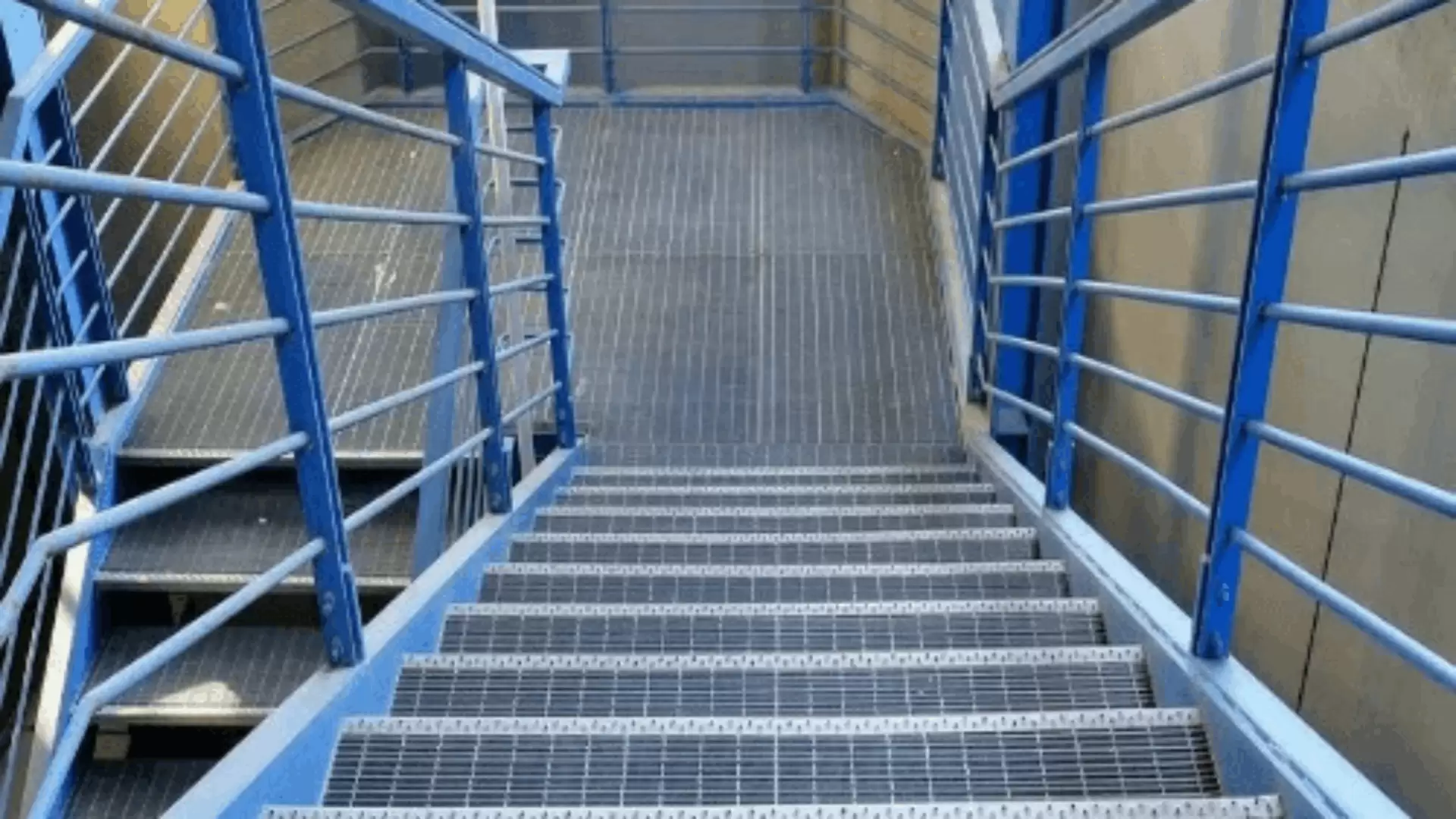
A steel stair tread is an open-grid metal step component that sits on stair stringers to form the walking surface of a staircase.
The open-grid construction allows water, oil, and fine debris to fall through the surface rather than accumulating and creating slip hazards.
Serrated bar surfaces and anti-slip nosing fitted at the leading edge provide additional grip protection in wet, oily, or industrial environments.
Steel stair treads outlast painted concrete and timber steps in harsh environments because they do not absorb moisture, corrode from within, or degrade under UV exposure.
Metal stair treads are the preferred choice for factories, power plants, oil rigs, marine facilities, and any staircase exposed to weather or industrial conditions.
Greatweld Engineering manufactures step grating and stair treads that combine structural strength, slip resistance, and long service life in a single fabricated component.
Greatweld Engineering Stair Treads: Product Specifications
Manufacturing types: electroforged, manually welded, and press-locked designs to match load, layout, and production volume requirements.
Material: high-quality mild steel as standard across all three tread types.
Surface options: serrated bars for wet and industrial environments with high slip risk; plain bars for dry, low-risk indoor applications.
Nosing: anti-slip steel nosing fitted to the leading edge of each tread for added safety at the step change point.
Finish: hot-dip galvanised as standard for outdoor and industrial environments. Powder-coated finish available for indoor commercial applications.
Standard widths range from 200 mm to 1000 mm and standard depths from 180 mm to 280 mm. Custom dimensions are available on request.
Standards compliance: ANSI/NAAMM MBG 531 for bar grating design; IS 2062 for mild steel material grade.
Types of Stair Treads Available
Electroforged Stair Treads
Electroforged stair treads are produced using an automated electric resistance welding process.
Bearing bars and cross bars are placed in a precision jig and fused at every intersection under high electrical current and clamping pressure.
This produces seamless, fully bonded joints with no voids or weak points across the entire step grating panel.
Electroforged treads deliver the highest load capacity and most consistent weld quality in the Greatweld Engineering range.
They are the correct specification for heavy industrial staircases in power plants, refineries, steel plants, and process industry facilities.
Serrated bar surface and hot-dip galvanised finish are supplied as the standard configuration for all electroforged stair treads.
Manually Welded Stair Treads
Manually welded stair treads are fabricated by hand using certified structural welders following a defined welding procedure.
The hand-welding process allows non-standard dimensions, irregular tread depths, and custom bar spacings to be achieved accurately.
This makes manually welded metal stair treads the right choice for retrofit projects, heritage buildings, and non-standard stair configurations.
Every manually welded tread from Greatweld Engineering is fabricated by certified welders and inspected dimensionally before dispatch.
Custom bar configurations and non-catalogue sizes can be produced through the manual welding process without additional tooling costs.
Press-Locked Stair Treads
Press-locked stair treads use a mechanical process where notched bearing bars receive cross bars pressed into them under controlled hydraulic pressure.
This creates a tight, flush-surface tread panel without arc-welding at every cross bar intersection.
The result is a clean, uniform appearance suited to commercial buildings, public staircases, and offices where aesthetics matter alongside function.
Press-locked step grating panels are produced efficiently for large standard-size orders without sacrificing structural performance.
Both plain and serrated bar surface options are available depending on the slip risk level of the specific stair environment.
Key Features and Benefits
Superior Safety and Performance
Serrated bar surfaces provide firm grip for heavy footwear in wet, oily, and dusty industrial stair environments.
Anti-slip nosing at the leading edge of each tread reduces the most common slip point in any staircase.
Open-grid step grating construction promotes drainage and ventilation rather than allowing moisture or debris to accumulate on the step surface.
These three features combined make steel stair treads the safest available walking surface for industrial staircases.
Durable, Cost-Effective and Eco-Friendly
Mild steel stair treads with hot-dip galvanising have a service life of 25 to 50 years in outdoor industrial environments with no repainting.
The open-grid design reduces material content compared to a solid plate step of equivalent size, lowering both cost and structural dead load.
All mild steel used by Greatweld Engineering is 100 percent recyclable, so metal stair treads at end of life contribute fully to material recovery.
Bolt-on or weld-on installation options reduce on-site labour time and allow faster staircase completion on any project schedule.
Manufacturing Process
All Greatweld Engineering stair treads begin with precision cutting of bearing bars and cross bars to the required dimensions from structural-grade mild steel.
For electroforged treads, bars are placed in an automated jig and fused at every intersection using the electric resistance welding process.
For manually welded treads, certified welders assemble and weld bars according to the project drawing specifications under workshop quality control.
For press-locked treads, notched bearing bars receive cross bars under controlled hydraulic press pressure to create a mechanically locked panel.
After fabrication, all tread panels undergo surface preparation by shot blasting to remove mill scale and prepare the steel surface for the coating.
Hot-dip galvanising is applied to the complete fabricated tread after all welding and forming, ensuring every surface receives full zinc protection.
Dimensional inspection is carried out on finished treads before dispatch to confirm that all sizes, nosing positions, and bar spacings match the order specification.
Applications
Factories and warehouses use steel stair treads on access staircases connecting production floors, mezzanines, and rooftop plant areas.
Construction sites use metal stair treads on both temporary and permanent access stairs for safe multi-level foot traffic during construction.
Oil rigs and marine facilities specify hot-dip galvanised stair treads and step grating for resistance to salt spray, moisture, and coastal corrosion.
Public infrastructure and commercial buildings use press-locked treads for clean, uniform pedestrian staircases in high-foot-traffic areas.
Industrial platforms and access stairways in power plants, refineries, and chemical facilities require electroforged stair treads for heavy-duty load performance.
Conclusion
Steel stair treads are a long-term safety investment that must match the specific load, environment, and access requirements of each staircase.
Greatweld Engineering manufactures electroforged, manually welded, and press-locked stair treads and step grating for industrial, commercial, and infrastructure projects across India.
As experienced stair tread manufacturers, our team can confirm the right tread type and specification based on your stair dimensions, load, and environment.
Contact Greatweld Engineering with your project details to receive a product recommendation and quotation.
Frequently Asked Questions (FAQs)
A steel stair tread is an open-grid metal step that allows drainage and ventilation through the surface. A solid plate step retains water and debris on the surface, increasing slip risk. Open-grid stair treads are safer and lighter than solid plate steps in industrial and outdoor environments.
Greatweld Engineering manufactures electroforged stair treads for heavy industrial applications, manually welded stair treads for custom and non-standard layouts, and press-locked stair treads for commercial and public staircase applications.
Electroforged stair treads use automated electric resistance welding to fuse bars at every intersection, producing seamless, high-strength joints for consistent heavy-duty performance. Manually welded treads are hand-fabricated by certified welders, allowing custom dimensions and irregular layouts not achievable through automated processes.
A press-locked stair tread uses hydraulic pressure to mechanically lock cross bars into notched bearing bars without arc welding at each junction. This produces a flush, clean-surface tread suited to commercial buildings, public staircases, and office facilities where appearance matters alongside safety.
Hot-dip galvanising is the standard finish for outdoor and industrial metal stair treads. Powder-coated finish is available for indoor commercial and architectural applications. All finishes are applied after full fabrication to protect every surface including welds and cut edges.